Key Lime Interactive

2025

AI Reporting for B2B

Keylime’s current Competitive Intelligence (CI) portal needs to become more marketable, strategic, and user-focused to better meet customer and business needs. This project aims to research and develop innovative redesigns, explore AI integration to enhance report value, and deliver research-backed design recommendations supported by testable prototypes for future implementation.

Role

UX Co-Lead

Timeline

Fall 2025

Team

6 Designers

Platform

Figma

Role

UX Co-Lead

Timeline

Fall 2025

Team

6 Designers

Platform

Figma

Contributions

Co-Lead

Assigned tasks to group members & championed specfic aspects of the project

Prototype

Created a mockup of our prototype in Figma to share with stakeholders for future developement

AI Sprint

Created and facilitated a sprint focusing on how AI is used in ways beyond reporting to begin brainstorming

Point of Contact

Was the primary point of contact with our stakeholders to schedule meetings and discuss updates

Co-Lead

Assigned tasks to group members & championed specfic aspects of the project

Prototype

Created a mockup of our prototype in Figma to share with stakeholders for future developement

AI Sprint

Created and facilitated a sprint focusing on how AI is used in ways beyond reporting to begin brainstorming

Point of Contact

Was the primary point of contact with our stakeholders to schedule meetings and discuss updates

The Problem

Keylime faces the challenge of enhancing its Competitive Intelligence (CI) portal to better meet customer needs and drive business value. While the current portal delivers useful reports, subscribers of these reports have been decreasing in recent years

The Solution

To clearly demonstrate how our concept would function within the Key Lime portal, we developed higher-fidelity mockups based on our original wireframes. While the screens illustrate how the chatbot could seamlessly integrate with the existing dashboard, the features are also designed to function independently if needed.

When a user selects the chatbot widget in the bottom right corner, the interface expands into a full feature view. This ensures the chatbot’s capabilities are immediately visible rather than hidden, encouraging engagement and reducing friction. Users can enter any type of question directly into the text field, enabling a flexible and intuitive experience.

The battlecard feature provides a concise, comparative snapshot of how a company stacks up against its competitors across relevant performance categories. By converting lengthy CI reports into a clear, visual card, this tool dramatically reduces the need for extensive scrolling and gives teams quick, actionable insights they can easily share.

The what-if analysis allows users to explore potential strategic changes before implementing them. Drawing on Key Lime’s rich historical dataset, this feature highlights the possible benefits, risks, and projected outcomes associated with a hypothetical shift. This empowers teams to make informed decisions backed by evidence and scenario modeling.

The Process

Heuristic Evaluation

For our heuristic evaluation, we used Nielsen’s 10 Ten Usability Heuristics as the guiding framework (Nielsen, 2024). These principles provided a structured way to systematically assess the KeyLime portal’s usability and identify issues related to user control, error prevention, consistency, and overall design quality.

Heuristic Evaluation

For our heuristic evaluation, we used Nielsen’s 10 Ten Usability Heuristics as the guiding framework (Nielsen, 2024). These principles provided a structured way to systematically assess the KeyLime portal’s usability and identify issues related to user control, error prevention, consistency, and overall design quality.

Comparative Analysis

We conducted an analysis with competitors by comparing product features to gain a deeper understanding of the competitive landscape, customer needs/expectations, and opportunities. We aimed to look into what they were selling; what was new, different, and innovative that we could draw on for our design recommendations.

Comparative Analysis

We conducted an analysis with competitors by comparing product features to gain a deeper understanding of the competitive landscape, customer needs/expectations, and opportunities. We aimed to look into what they were selling; what was new, different, and innovative that we could draw on for our design recommendations.

Comparative Analysis

We conducted an analysis with competitors by comparing product features to gain a deeper understanding of the competitive landscape, customer needs/expectations, and opportunities. We aimed to look into what they were selling; what was new, different, and innovative that we could draw on for our design recommendations.

Ideation

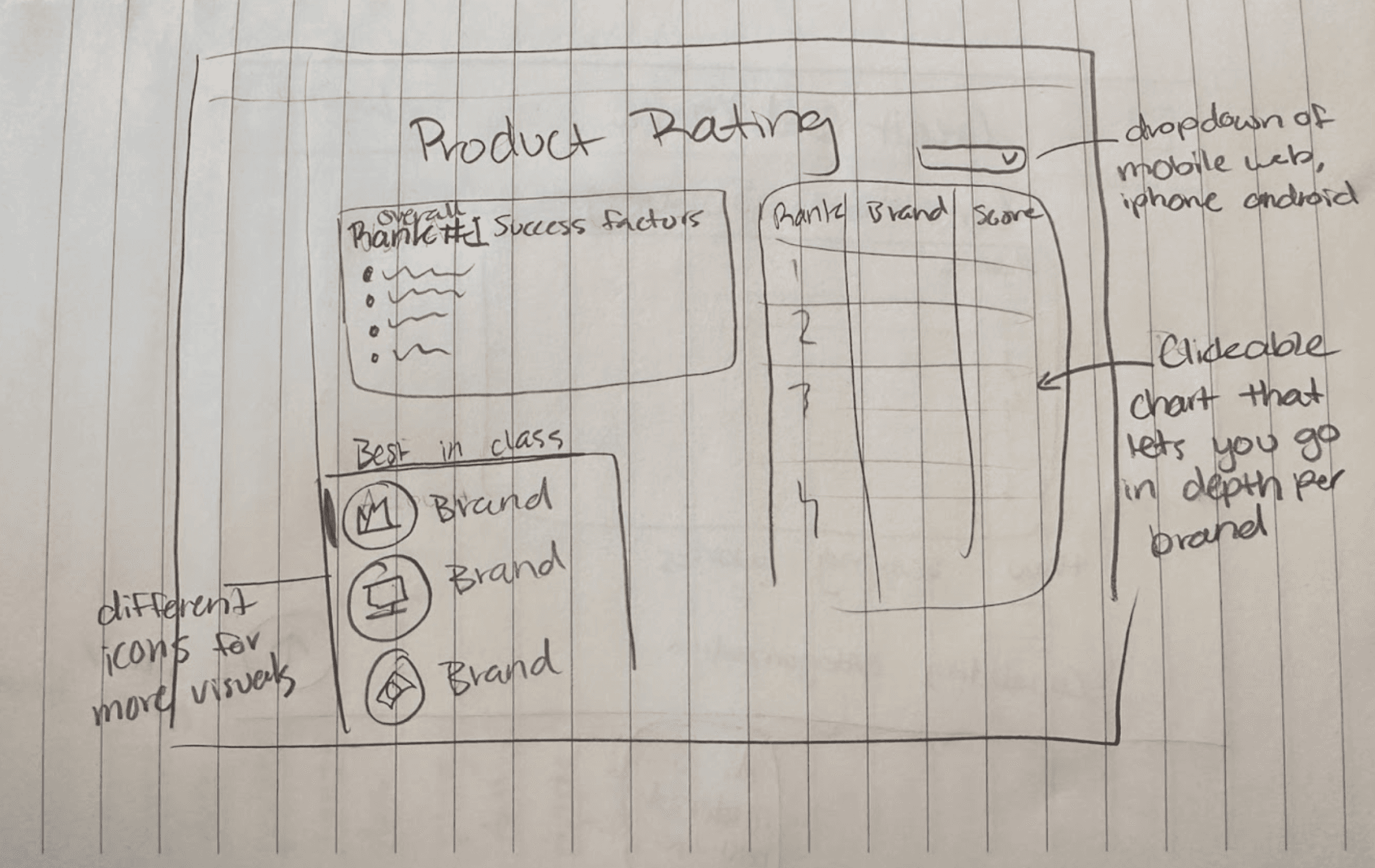
This sketch aims to improve the visual hierarchy of the “Product Rating” page.  Using boxes or cards to emphasize and group important information could allow for a more visually appealing way to look at reports.


Ideation

This sketch aims to improve the visual hierarchy of the “Product Rating” page.  Using boxes or cards to emphasize and group important information could allow for a more visually appealing way to look at reports.


Ideation

This sketch aims to improve the visual hierarchy of the “Product Rating” page.  Using boxes or cards to emphasize and group important information could allow for a more visually appealing way to look at reports.


AI Sprint

By leading this sprint, I wanted to analyze different companies and products across multiple industries, searching for implementations of AI to draw inspiration from.

These examples tackle shareability, added visuals, and quick insights

AI Sprint

By leading this sprint, I wanted to analyze different companies and products across multiple industries, searching for implementations of AI to draw inspiration from.

These examples tackle shareability, added visuals, and quick insights

AI Sprint

By leading this sprint, I wanted to analyze different companies and products across multiple industries, searching for implementations of AI to draw inspiration from.

These examples tackle shareability, added visuals, and quick insights

All of these activities allowed us to come to our final solution which you can find at the top of this page!

All of these activities allowed us to come to our final solution which you can find at the top of this page!

All of these activities allowed us to come to our final solution which you can find at the top of this page!

Impact & Reflection

Collaborating with a team of 7 others on a project focusing on the integration of AI was a great learning experience for me, especially in the time of rapid AI adoption in product design. I took on roles such as a mentor, meeting lead, planning lead, as well as a fellow UX designer among my peers. Because this project was in partnership with a startup, it will have an impact on the future state of CorpusKey and how their products evolve.

Impact & Reflection

Collaborating with a team of 7 others on a project focusing on the integration of AI was a great learning experience for me, especially in the time of rapid AI adoption in product design. I took on roles such as a mentor, meeting lead, planning lead, as well as a fellow UX designer among my peers. Because this project was in partnership with a startup, it will have an impact on the future state of CorpusKey and how their products evolve.

Impact & Reflection

Collaborating with a team of 7 others on a project focusing on the integration of AI was a great learning experience for me, especially in the time of rapid AI adoption in product design. I took on roles such as a mentor, meeting lead, planning lead, as well as a fellow UX designer among my peers. Because this project was in partnership with a startup, it will have an impact on the future state of CorpusKey and how their products evolve.